One library. One front door.
Plex turns the files stored on Watts Home Server into a browsable media library with artwork, metadata and a consistent interface across supported devices.
MEDIA TODAY • LEGACY TOMORROW
A purpose-built home server for media, storage and a family archive designed to last.
Explore the server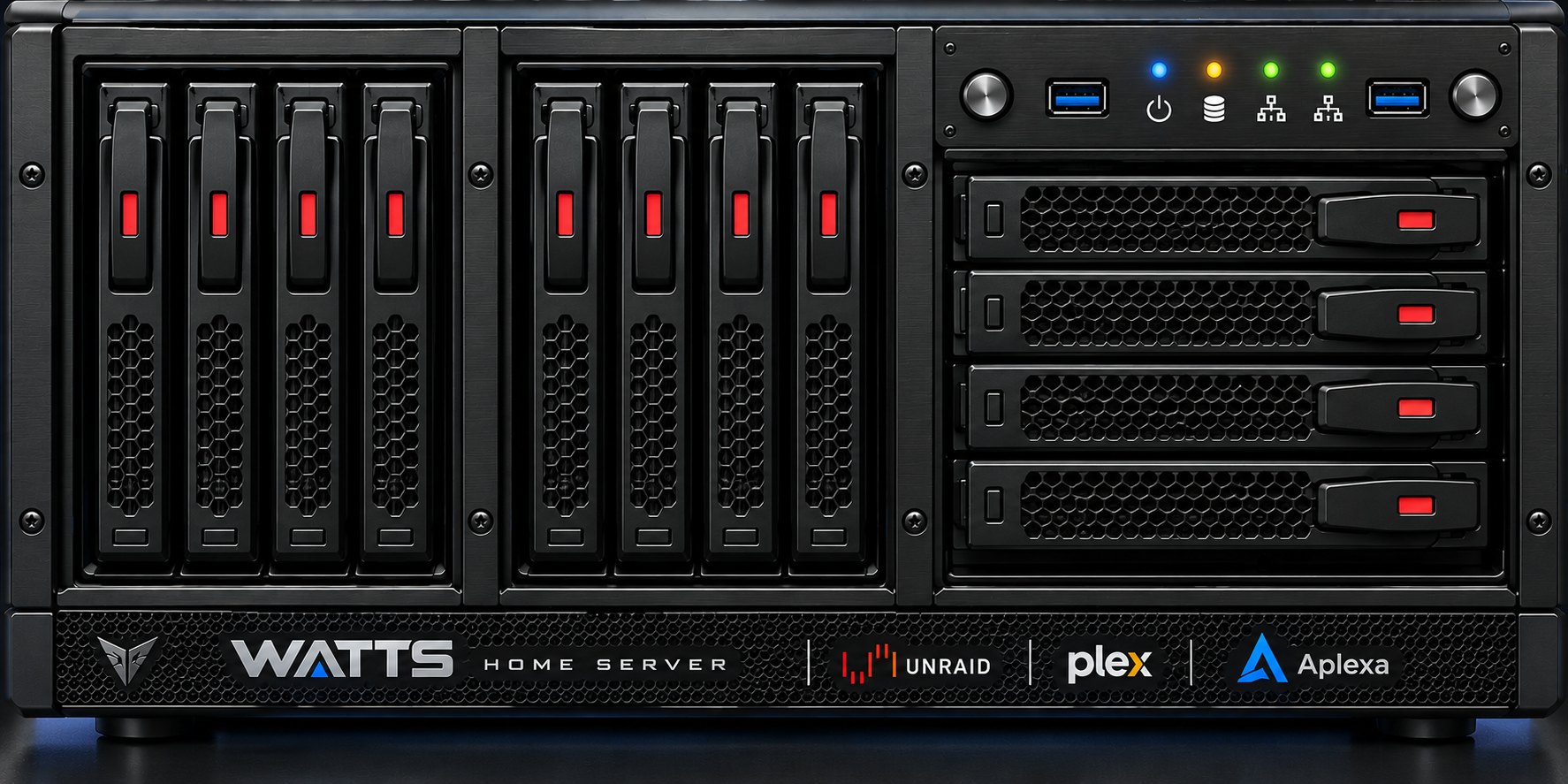
MEDIA / PLEX
Plex is the viewing layer of Watts Home Server: one organized home for the movie and television library, backed by Unraid storage and a dedicated GPU assigned specifically to media transcoding.
The NVIDIA Quadro P1000 4 GB is dedicated to Plex hardware transcoding. When a client needs a different format, bitrate or resolution, the P1000 handles the conversion work instead of competing with the RTX 3060.
Direct play stays direct whenever the client supports the media. When transcoding is required, the dedicated P1000 steps in.
Plex turns the files stored on Watts Home Server into a browsable media library with artwork, metadata and a consistent interface across supported devices.
Compatible clients can play media without conversion, preserving quality and avoiding unnecessary transcoding work.
When conversion is necessary, the Quadro P1000 is the assigned Plex transcoder, keeping media work separate from the server's AI accelerator.
Plex is the presentation layer; the collection itself remains part of the larger Watts Home Server goal of organized, maintainable long-term storage.
UNRAID
Unraid provides the flexible storage platform behind Watts Home Server, allowing the system to grow and change without turning the public website into an administration console.
Private administration stays private. No Unraid management interface is exposed here.
APLEXA / THE LEGACY LAYER
Aplexa is where Watts Home Server becomes more than hardware. It is the identity built around preserving the collection, the memories attached to it, and the pieces of family history worth carrying forward.
“Media Today • Legacy Tomorrow”
Keep movies, television and the rest of the collection organized, accessible and ready to enjoy instead of scattered across devices and shelves.
Storage is only the beginning. Aplexa is about maintaining the material worth keeping so the collection remains useful instead of slowly disappearing.
A library becomes more valuable when it carries context—what it is, why it was kept, and why someone in the future might care about it.
The long-term goal is simple: build something that can outlive today's hardware and remain understandable, maintainable and meaningful.
HARDWARE / THE BUILD
Watts Home Server is a working home server, not a showroom spec sheet. The current build combines an Intel platform, two NVIDIA GPUs, dedicated 2.5 GbE networking and an LSI HBA feeding the Unraid array.
The new compute platform at the center of the rebuild.
DDR4 platform with the expansion room needed for the server's add-in cards.
System memory for Unraid and the services running on top of it.
Reserved for local AI and accelerated-compute duties, separate from Plex transcoding.
Dedicated to Plex hardware transcoding so media conversion stays off the RTX 3060 AI accelerator.
A dedicated two-port 2.5-gigabit network adapter supplements onboard networking.
The LSI HBA connects eight current array drives directly to Unraid.
Power capacity for the drive array, dual GPUs, expansion cards and cooling system.
AIRFLOW & COOLING
Cool air enters through the front and passes across the 3.5-inch drives first. Three 120 mm fans mounted behind the drive cages pull that air directly past the drives. Three additional 120 mm chassis fans keep it moving rearward, where two Noctua 80 mm fans exhaust the warmed air from the case.
BUILD EVOLUTION
The current Intel B760 / Core i5 platform succeeds the earlier Ryzen / X470 configuration while retaining the parts that still make sense: the chassis, storage infrastructure, GPUs and expansion hardware. Watts Home Server is designed to be rebuilt and improved rather than replaced as a whole.
PUBLIC STATUS
Watts Home Server is in the middle of its Intel platform rebuild. This public panel reports only intentionally published milestones; administration, internal addresses and private services remain private.
When the rebuilt server is proven stable, this panel can graduate from upgrade status to sanitized live service health.
Manual test only. No visitor gets surprised by an automatic klaxon.
ABOUT / THE STORY
Kenneth Watts is a lifelong builder, tinkerer and problem solver whose path has crossed food service and management, manufacturing, automotive mechanics, welding and fabrication, advertising research, computers, networking and website design.
Hands-on work came first: kitchens, manufacturing, automotive work, welding and management. Later, formal study in Computer Technology and Website Design brought that same maker mentality into hardware, networking and the web. When physical limitations changed the shape of the workshop, the desire to create did not disappear—the workshop became increasingly digital.
While researching Plex, Kenneth kept running across Unraid and the home-server community built around it. The first server came together from roughly three usable drives and hardware that had been collecting dust. It was modest, but it worked. Then came the familiar home-server question: what can I improve next?
The default Unraid name Tower never felt like much of an identity. The machine existed primarily for Plex, and while thinking about what it really was, a simple phrase stuck: it was a Plex thing. From that, Aplexa was born.
What began with a few spare drives kept evolving into Watts Home Server: storage, media, networking, compute and experimentation in one continually rebuilt system. Aplexa now connects those media-server beginnings with the longer goal—keeping what matters useful, understandable and available for the future.
Questions, comments, or something worth sharing?
MEDIA TODAY • LEGACY TOMORROW
The Twelve have been assembled. The Immutable Configuration has been satisfied.